Thursday, September 20, 2007

About Wyoming

Wyoming writer, poet, journalist and non-fiction author Tom Rea has a new web site.

Among the many interesting things on the site, we especially like the Vignettes from Wyoming's Past, which are ". . . true narratives from Wyoming history. . . . prepared for the American History Cowboy Coalition, a federally funded Teaching American History program in the Natrona County School District in Casper, Wyoming."

Enjoy!

Wednesday, September 19, 2007

Aye


Aye.
Originally uploaded by elvissa
In honor of International Talk Like a Pirate Day, the Chronicle of Higher Education, provides us these tips on Pirate Day humor:
To these recommendations, we add

Tuesday, September 18, 2007

:-P

Some of us experienced mixed feelings when the David Shipley and Will Schwalbe, authors of Send: The Essential Guide to Email for Office and Home, plunked themselves firmly on the side of emoticons in emails: "Even though we're well out of junior high, we like emoticons and think there are good uses for them. . . . Emoticons are an attempt to put a human face on faceless, quick communication" (134).

Regardless of how we may feel about the ubiquitous smiling faces, tomorrow--Wednesday, 19 September 2007--is the 25th birthday of the emoticon. :o)

Scott E. Fahlman, a professor of computer science at Carnegie Mellon University, invented the digital smiley face and first made use of it in the following email message:

9-Sep-82 11:44 Scott E Fahlman :-)
From: Scott E Fahlman

I propose that the following character sequence for joke markers:

:-)

Read it sideways. Actually, it is probably more economical to mark things that are NOT jokes, given current trends. For this, use

:-(

Celebrate the computer smiley's birthday by reading how Professor Fahlman created the original at Smiley Lore :-)

P.S. Our favorite smiley is the Santa emoticon:

For Pete's Sake--Get Some Sleep!

Yesterday after a student repeatedly fell asleep in our class (and after we had lost patience with kindly awakening him), we finally had to ask him to leave and go take a nap elsewhere. Convinced that our scintillating teaching style is not at fault, we wonder why so many students are snoozing through classes these days.

The Chronicle of Higher Education's News Blog has reported on recent studies which suggest students really do need their sleep, albeit not necessarily during class time:
Pulling an all-nighter may get a paper done, but the time-honored practice hurts students, according to two recent studies. Students who burned the midnight oil at St. Lawrence University had lower GPA’s, and night owls on the women’s basketball team at Stanford University were slower and missed more shots, USA Today reported.

But colleges are doing more to help their students rest easy, the article said. The University of California at Los Angeles and the University of Maryland at College Park are giving workshops on sleep disorders; Rice University has a campaign for a regular bedtime; and Duke University offers stressed-out students an “Oasis” with ample windows, a fountain, and a massage chair. [emphasis and links added]

Tuesday, August 28, 2007

Back to School Special . . . from Firefox!

This just in from the Chronicle of Higher Education's Wire Campus newsletter:
Firefox Releases New 'Campus Edition' Web Browser

It’s the time of year to stock up on school supplies — new spiral notebooks, pens, and … a new Web browser. Last week Mozilla, maker of the popular Firefox Web browser, released Firefox Campus Edition for free download.

logoA key feature of the new browser is the Zotero citation system developed by George Mason University’s Center for History and New Media, noted here last year. The system is designed to help students and scholars mark and manage information on the Web that they want to cite in research papers.

The campus edition browser is not all work and no play, though. It also includes a plug-in called FoxyTunes that helps manage the soundtrack to cram sessions, and StumbleUpon, a service to quickly jump among favorite blogs, online videos, and photo Web sites.—Jeffrey R. Young

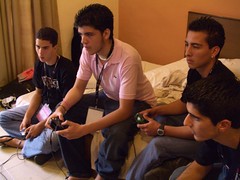
Roommate with a Video-Game System?

photo of Halo players
Halo Gamers
Originally uploaded by Bilbeny
When your parents deposited you in your residence hall room (sob!), they were looking (surreptitiously or not) for the tell-tale signs of your inevitable (they fear) moral dissolution. But did they check your new roommate's gaming gear?

Today's Chronicle of Higher Education reports on a study which links a roommate's gaming gear with less study time:
According to a paper scheduled for release this week by the National Bureau of Economic Research, first-year college students who happen to be assigned roommates with video-game consoles study 40 minutes less per day, on average, than first-year students whose roommates did not bring consoles.

And that reduction in study time has a sizable effect on grades: First-year students whose roommates brought video-game consoles earned grades that were 0.241 lower, on a 4-point scale, than did otherwise-equivalent students whose roommates did not have consoles.
What to do? The Chronicle reports that the researchers conclude "The important lesson of their research . . . is that colleges should encourage effort, frequently reminding their students that study time pays off."

The research article--"The Causal Effect of Studying on Academic Performance"-- is available online for a fee from the National Bureau for Economic Research.

Monday, August 27, 2007

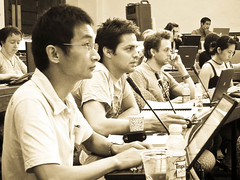
Attention

photo of laptops in a class
Attention
Originally uploaded by Felix42 contra la censura
Increasingly, students bring their computers to class and faculty take theirs to meetings. Is everyone, however, paying attention to business? Who is checking email or sneaking a look at ESPN or sending snide notes via IM? What is the correct etiquette for this situation?

According to a recent article in The New York Times, there are no clear guidelines, although Microsoft Corporation makes use of 7 Rules for Using Laptops in Meetings:

  1. Make sure there's a point. Don't take laptops to meetings unless you need one for a particular task, such as a presentation.
  2. Designate a laptop. Put one person in charge of computer duties, for note-taking or PowerPoint projection.
  3. Be ready to explain why you've brought a laptop. It's just good manners to let the meeting organizer know what you've brought a computer along.
  4. Use some discretion. Be sure to look up from your machine, use eye contact, and stay involved with the meeting. Tablet PCs are less distracting than regular laptops because they eliminate the screen barrier.
  5. Turn down the bells and whistles. Be sure you mute any sort of noise or sound that may prove distracting or annoying to others.
  6. When in doubt, leave them out. Sometimes, it's appropriate to ask people to leave their laptops behind.
  7. Dissect your meetings. If people aren't paying attention to the content of your classes or meetings, then take a hard look at the way you organize the session. Meetings that are well planned and well run help keep participants focussed.

Tuesday, August 21, 2007

"I keep getting older; they stay the same age."

Beloit College has released its annual Mind-Set List which attempts to to identify a worldview of 18 year-olds in the fall of 2007: "Its 70 items provide a look at the cultural touchstones that have shaped the lives of today’s first-year students, most of them born in 1989."

Here are the first 12 items on the list; you can see the entire list of 70 on the Beloit College website:
  1. What Berlin wall?
  2. Humvees, minus the artillery, have always been available to the public.
  3. Rush Limbaugh and the “Dittoheads” have always been lambasting liberals.
  4. They never “rolled down” a car window.
  5. Michael Moore has always been angry and funny.
  6. They may confuse the Keating Five with a rock group.
  7. They have grown up with bottled water.
  8. General Motors has always been working on an electric car.
  9. Nelson Mandela has always been free and a force in South Africa.
  10. Pete Rose has never played baseball.
  11. Rap music has always been mainstream.
  12. Religious leaders have always been telling politicians what to do, or else!

Wednesday, August 01, 2007

Bulwer-Lytton Fiction Contest

Gerald began—but was interrupted by a piercing whistle which cost him ten percent of his hearing permanently, as it did everyone else in a ten-mile radius of the eruption, not that it mattered much because for them “permanently” meant the next ten minutes or so until buried by searing lava or suffocated by choking ash—to pee.
This execrable sentence erupted from the molten mind of Jim Gleeson, the 2007 grand-prize winner of the Bulwer-Lytton Fiction Contest. And he's not even an English major, but a media technician.

For 25 years, the English Department at San Jose State University has sponsored the Bulwer-Lytton Fiction Contest, which challenges contestants to write the worst possible first sentence for the worst of all possible novels.

You can read the 2007 winners for all categories on the contest's web site, but we'll leave you with the winner of the Vile Pun category:
I was in a back alley in Fiji, fighting desperately and silently for my life, fighting desperately for oxygen, clawing at the calm and almost gentle pressure of the fabric held over my face by implacable, ebony thighs when I realized -- he was killing me softly with his sarong. (Karl Scott, Brisbane, Australia)

Read Well, Live Longer

We've long known that education levels correlate to longevity. The New York Times notes that "one study found that people who did not graduate from high school lived an average of nine years less than graduates." Education, it seems, adds to one's health literacy, which then leads to a longer life.

What's new, however, is that one particular characteristic of lower education levels may cause the problem: poor reading skills. A recent study from the Archives of Internal Medicine finds that reading level "independently predicts all-cause mortality and cardiovascular death among community-dwelling elderly persons."

As nHumanities has always known, reading is good for you!

(Illustration John Gilbert, "A Death Unexpected by the Reader," DMVI: ALS019 .)