Wednesday, August 24, 2005

Poets, go forth and rhyme!

McgonagallWilliam Topaz McGonagall has the reputation, many would say justly earned, of being the worst poet in the world. Vasudev Murthy, writing in the Deccan Herald of Karnataka, India, provides a nice summary of McGonagall's career. Born in 1825, McGonagall reports that at the age of 57
"I was sitting in my back room in Paton’s Lane, Dundee, lamenting to myself because I couldn’t get to the Highlands on holiday to see the beautiful scenery, when all of a sudden my body got inflamed, and instantly I was seized with a strong desire to write poetry, so strong, in fact, that in imagination I thought I heard a voice crying in my ears--'Write! Write!' "

Write he did, as well as recite, in spite of the tomatoes and eggs which were frequently flung at him during his readings. McGonagall came to specialize in poetry about disasters such as train wrecks. Here is a sample of his verse in his famous "The Tay Bridge Disaster":

Beautiful Railway Bridge of the Silv'ry Tay!
Alas! I am very sorry to say
That ninety lives have been taken away
On the last Sabbath day of 1879,
Which will be remember'd for a very long time.

For more information on the immortal McGonagall, check out:
Worst Poet in the World, by Vasudev Murthy, Deccan Herald
McGonagall OnLine
-- An extensive collection of poetry and prose, as well as links to other sites.

Friday, July 29, 2005

The Bulwer-Lytton Fiction Contest

"It was a dark and stormy night; the rain fell in torrents--except at occasional intervals, when it was checked by a violent gust of wind which swept up the streets (for it is in London that our scene lies), rattling along the housetops, and fiercely agitating the scanty flame of the lamps that struggled against the darkness." --Edward George Bulwer-Lytton, Paul Clifford (1830)

Snoopy cartoon The Bulwer-Lytton Fiction Contest from San Jose State University annually honors the dark-and-stormy-night memory of Edward George Bulwer-Lytton, author of one of the more infamous leads in literary history. The 2005 winners are just now posted online according to categories (Adventure, History, Grand Panjandrum, etc.). Enjoy!

Monday, July 25, 2005

Grammar IQ Challenge Quiz

punctuation graphicCapital Community College of Hartford, Connecticut, sponsors a wonderful web site called Guide to Grammar and Writing which offers clear, accurate, easy-to-navigate help on grammar and writing rules. As the web site's "Caveat Lector" page says,

Like learning to drive, learning to write is largely a matter of learning from others and, more than anything else, practicing in a safe place until you can operate with skill and confidence. Still, there are many who will write with more confidence when they know the rules. So here are some rules, some definitions, some prescriptions, some quizzes, even a place to ask questions. We hope they prove helpful.

Try the web site's Grammar IQ Challenge Quiz to see how confident you are on some common grammar questions.

Tuesday, July 19, 2005

Glossary for Medieval Art and Architecture

What is a donjon? At the Glossary for Medieval Art and Architecture, you click on a term to get definition, illustration, and definition. Cool!

Games for the Brain

Games for the Brain logoGames for the Brain makes it possible for you to "Play neverending quiz and memory games to train your thinking skills."

Monday, July 18, 2005

Golden Age Romance Comics

Glamous Romances comic cover The Archive of Golden Age Romance Comics is "a resource for scholars and fans interested in golden era romance comics, containing full scans of issues."

What? You say you've never heard of golden age romance comics before? Interestingly enough, the web site's essay on the genre explains that these comics represented the first and last time that adult American women were major consumers of comics:
Romance comics were one of five major genres of adult comics which boomed after World War II. The so-called golden-age of comics began in 1935 and ended at about the time of the self-imposed Comics Code of 1954. The main period of interest to this archive is the third phase of the golden era, from 1948 to 1954. During this period comic readership was at its height, and adults, both men and women, were a major piece of the market. These years saw comic sales approach 60 million issues per month, and a 1950 government-sponsored study of an Ohio town revealed that 54 percent of all comic readers were over 20-years old, and that the average reader bought about 11 comics per month.
All you Westerners be sure to check out Rangeland Love, which features stories such as "The Trail of the Purple Sage" and "Redhead on the Range!"

The Complete Review

Complete Review header
The Complete Review is an online book review site. Currently, it catalogues 1,443 book reviews which visitors can browse by genre, title, author, or rankings (a grading scale, with A+ as the tip-top).

The web site also includes links to outside reviews (mostly from British periodicals) and a link to the CR's weblog The Literary Saloon. (No, that's not a typo for salon . . . it really is saloon!)

Friday, July 08, 2005

Their Circular Life :: Cool Site o' the Day

Their Circular Life is an Italian web site which provides "an exploration about human behaviour." Using Flash technology, the web site allows you to explore the 24-hour interaction of humans with five different landscapes.

Their Circular Life provides a beautiful, thought-provoking glimpse into daily life--sights and sound as affected by the passage of time.

Thursday, July 07, 2005

"War of the Worlds": Behind the 1938 Radio Show Panic

The Spielberg/Cruise War of the Worlds movie has enjoyed a good opening weekend, but its impact is nothing like what happened in 1938.

According to National Geographic News's article "War of the Worlds": Behind the 1938 Radio Show Panic, thousands of people believed they were under attack by Martians:
It was the day before Halloween, October 30, 1938. Henry Brylawski was on his way to pick up his girlfriend at her Adams Morgan apartment in Washington, D.C.

As he turned on his car radio, the 25-year-old law student heard some startling news. A huge meteorite had smashed into a New Jersey farm. New York was under attack by Martians.

"I knew it was a hoax," said Brylawski, now 92.

Others were not so sure. When he reached the apartment, Brylawski found his girlfriend's sister, who was living there, "quaking in her boots," as he puts it. "She thought the news was real," he said.

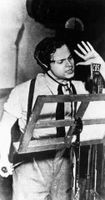
It was not. What radio listeners heard that night was an adaptation, by Orson Welles's Mercury Theater group, of a science fiction novel written 40 years earlier: The War of the Worlds, by H.G. Wells.

However, the radio play, narrated by Orson Welles, had been written and performed to sound like a real news broadcast about an invasion from Mars.

Reportedly, Welles had no idea that his broadcast would result in widespread panic: "According to the New York Times, Welles expressed profound regret that his dramatic efforts could cause consternation. "I don't think we will choose anything like this again," he said. He hesitated about presenting it, Welles said, because "it was our thought that perhaps people might be bored or annoyed at hearing a tale so improbable."

But in 1938, America was rattled by what it was already hearing on the radio and primed for more bad news, no matter how improbable. As The War of the Worlds Invasion: The Historical Perspective explains,

Americans were now able to connect with events and hear their law and opinion makers as never before. A notable trailblazer in this regard was President Franklin D. Roosevelt, whose "fireside chats" (beginning in 1933) brought the voice of government and authority into the home as never before. Major news events also gripped the nation. Bulletins on the hunt for the kidnapped baby son of aviator Charles Lindbergh kept listeners in an agony of suspense over several months in 1932 and in 1936 the war correspondent Hans Von Kaltenborn became the first American reporter to broadcast live from a war zone, when he brought the actual sounds of a Spanish civil war battle into ordinary homes. Equally dramatic was the fatal crash of the airship Hindenburg, recorded on May 6th 1937 by Herbert Morrison of Chicago station WLS, an event that reduced the helpless reporter to tears of frustration and horror. Undoubtedly however, it was the troubling broadcasts from Nazi Germany that did most to unsettle America in this period. During the Munich Crisis of September 12-30th 1938, more radios were sold to anxious Americans than in any previous three-week period, as Hitler rallied his forces and the world slid inexorably toward war.
Orson Welles and his colleagues were preparing their broadcast for an unsuspecting nation which was already tense.

Wednesday, July 06, 2005

Beach Bag of Books

Don't know what to read this summer? Check out these resources: