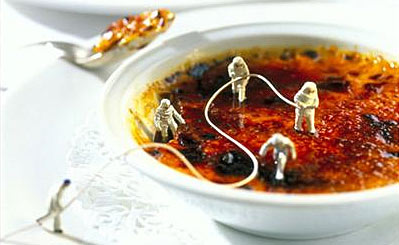
A tiny hazmat team cleaning up a crème brûlée spill . . . and other delights. It's the work of culinary photographers Akiko Ida And Pierre Javelle, as reported via Boing Boing.

 news@nature.com reports that the best way to make a complex decision is to think about something else . . . and then just decide. While simple decisions benefit from some forethought, "At least when making some complicated decisions, such as choosing a car or house, the results suggest that we would actually do better to go with our gut."
 According to a study reported in Journal of Personality and Social Psychology, you've got only a 50-50 chance of correctly interpreting the tone of emails. And yet most people (90%) think they understand the tone of their emails perfectly:
The researchers took 30 pairs of undergraduate students and gave each one a list of 20 statements about topics like campus food or the weather. Assuming either a serious or sarcastic tone, one member of each pair e-mailed the statements to his or her partner. The partners then guessed the intended tone and indicated how confident they were in their answers.You can access the full article--"Egocentrism over E-mail: Can We Communicate as Well as We Think?" (Dec 2005)--online at the journal's web site.
Those who sent the messages predicted that nearly 80 percent of the time their partners would correctly interpret the tone. In fact the recipients got it right just over 50 percent of the time.
"People often think the tone or emotion in their messages is obvious because they 'hear' the tone they intend in their head as they write," Epley explains.
At the same time, those reading messages unconsciously interpret them based on their current mood, stereotypes and expectations. Despite this, the research subjects thought they accurately interpreted the messages nine out of 10 times.
 Bill Graham Presents produced more than 350,000 concerts all over the world and recorded thousands of them. In 2003, Wolfgang's Vault acquired those tapes and now presents selections online via Vault Radio. Just go to the web site and click PLAY NOW! Ah . . . it sounds like my dorm room.
 Black History month, observed in February, has its roots in cultural celebrations that have existed since 1926. Just in time for this year's observance, the library at University of North Carolina at Chapel Hill has released a list of reliable Web sites on black culture and history.
 Gary Price's information weblog the ResourceShelf has published a special list of online information about the 2006 Winter Olympics


"I’ve convened this commission to ensure that America remains the world’s leader in higher education and innovation,” because “the world is catching up,” the secretary said, noting that the U.S. now ranks seventh internationally in college graduation rates. “And we’re not keeping pace with the demand for skilled labor in the new high-tech economy,” she added, quoting Tom Friedman in arguing that “our students are facing and education and ambition gap, and they’re on the wrong side."Secretary Spellings asked the panel's Chair, Charles Miller of Texas, to focus on four areas: "accessibility, affordability, accountability and quality."
Mr. Miller said he was not envisioning a higher education version of the No Child Left Behind Act, which requires standardizing testing in public schools and penalizes schools whose students do not improve. "There is no way you can mandate a single set of tests, to have a federalist higher education system," he said. But he said public reporting of collegiate learning as measured through testing "would be greatly beneficial to the students, parents, taxpayers and employers" and that he would like to create a national database that includes measures of learning.We at nHumanities admit we find no comfort in Miller's remark that he's not "envisioning a higher education version of the No Child Left Behind Act," for we remember the old adage, if it walks like a duck, quacks like a duck, and looks like a duck, it must be a duck. We've seen how these things work before, and the odds are excellent that very shortly after that "national database" has been created, efforts will be underway to tie the performance of individual colleges to the receipt of federal funds. From our perspective in the trenches of community college education, NCLB has made matters worse, not better. A similar approach for colleges is wrong-headed at best and destructive at worst.

nHumanities is the web log of the Humanities Division at Northwest College (Powell, Wyoming).

 Posts
All Comments
Posts
All Comments

 ms.dsk is reading Résistance: Memoirs of Occupied France, by Agnès Humbert (trans. Barbara Mellor)
 Rob Koelling is reading Anathem, by Neal Stephenson
 S. Renee Dechert is reading Storey's Guide to Raising Turkeys: Breeds, Care, Health, by Leonard S. Mercia
 Mary Ellen Ibarra-Robinson is reading The Memory of Water, by Karen White
 Bill Hoagland is reading Trash Fish: A Life, by Greg Keeler
 Jennifer Sheridan is reading The Stuff of Thought: Language as a Window into Human Nature, by Steven Pinker
 Robyn Glasscock is reading poetry by Marianne Moore
 Susan Watkins is reading Under the Banner of Heaven: A Story of Violent Faith, by Jon Krakauer


